
A new home for culinary enterprise in central Singapore.
Harrison Food Building is a freehold, eight-storey food factory development at 7 & 9 Harrison Road — purpose-built for central kitchens, bakeries, sauce works, packaging operations and large-format food manufacturers. Forty-two exclusive units, full ramp-up access to every floor, and an SFA-ready specification.
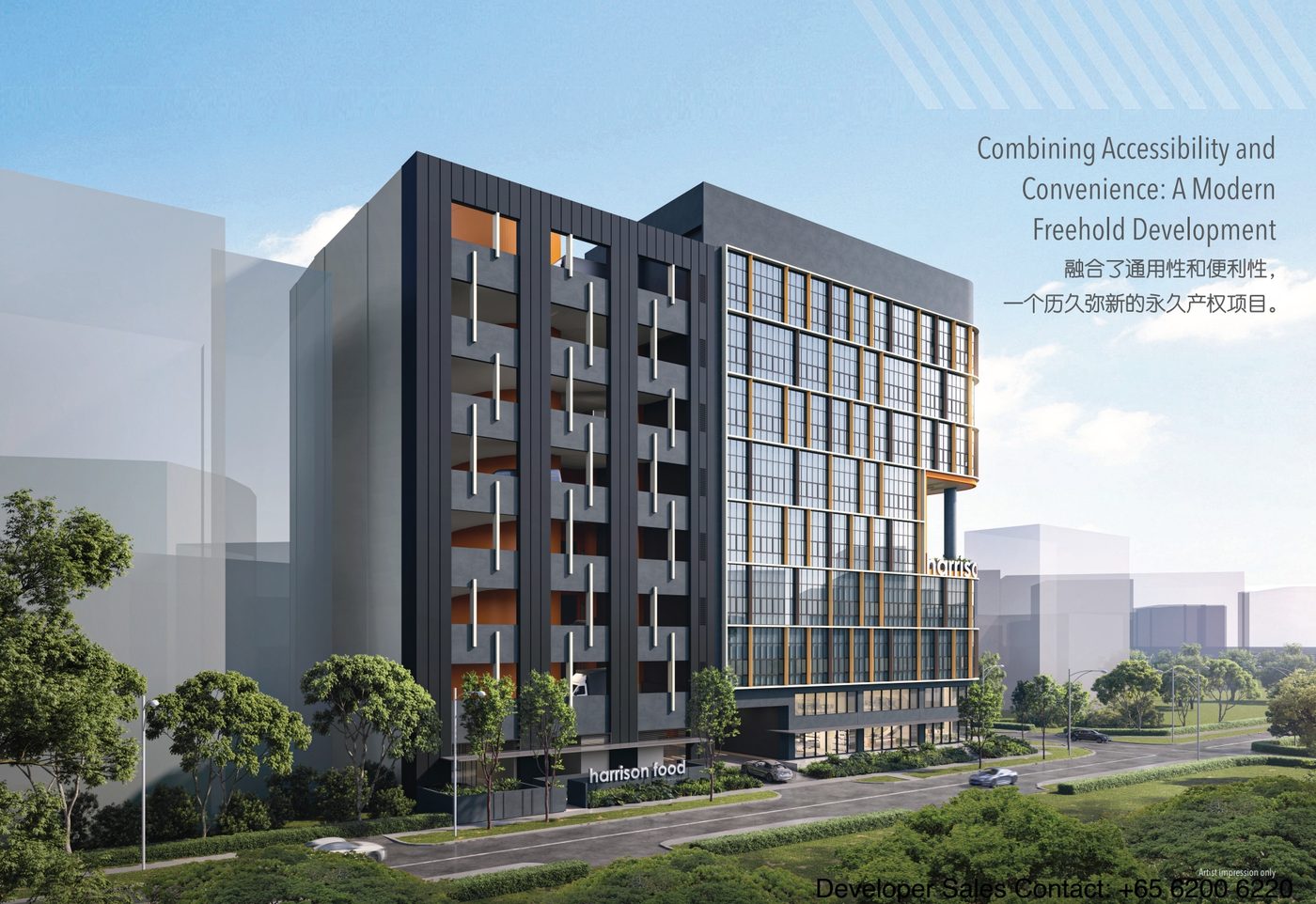
One of Singapore’s last new-build freehold food factories.
Freehold food factories at this scale, in a central postcode, with full ramp-up access, are vanishingly rare in Singapore. The overwhelming majority of food factory stock in the market sits on 30 or 60-year JTC leasehold tenure. Harrison Food Building is one of a small handful of recent freehold projects — and the only freehold food factory currently launching in the Tai Seng cluster, where Paya Lebar iPark and Bartley Industrial form the wider context.
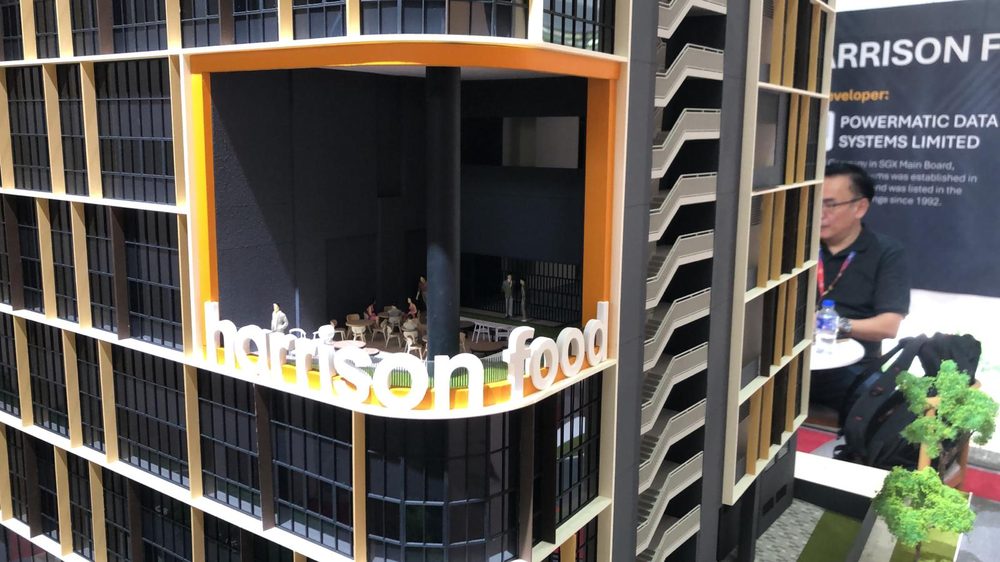
The building is developed by SGX Mainboard-listed Powermatic Data Systems Ltd, the same group whose two-adjoining six-storey buildings previously occupied this site. The redevelopment lifts the site to a modern eight-storey factory with a full-height vehicular ramp, SFA-ready specifications, dedicated loading bays, a sky terrace at Level 4, and a self-contained industrial canteen at Level 1.
For owner-occupiers in the food sector, the building offers permanent ownership with no lease decay — a meaningful difference when planning capital expenditure on cold rooms, kitchen exhausts and food-safety certifications that typically have multi-decade payback profiles. For investors, the same freehold tenure underpins long-term value, set against a backdrop of tightening industrial supply in the Rest of Central Region.
Indicative pricing starts from approximately S$2.8 million, with per-square-foot quanta opening from the S$17xx psf range, depending on level, unit type and orientation. For a precise quote on a specific stack, please contact the developer sales team.

Eight reasons the food sector is watching this launch.
Specification, location, tenure and developer credibility — the four variables that determine whether a food-factory acquisition pays back over the long run.
Freehold tenure
Permanent ownership with no lease decay, in a market where most food factory stock is 30 or 60-year leasehold from JTC.
Full vehicular ramp
Goods vehicles drive directly to every floor from Level 1 to Level 8 — no waiting for cargo lifts.
SFA-ready specification
Floor loadings, ceiling heights, exhaust provisions and grease traps designed to support SFA food-factory licensing from day one.
5 minutes to Tai Seng MRT
Direct Circle Line access for staff and clients, plus quick connections to North-East, East-West and Downtown lines.
Three expressway access
Eight minutes to PIE and CTE, fifteen to Changi Airport and the CBD — vital for cold-chain and ready-to-eat logistics.
SGX-listed developer
Powermatic Data Systems Ltd brings institutional financial discipline and a 30-year track record across hardware and real estate.
Built-in industrial canteen
Level 1 unit #01-01 is a 318 sqm dedicated industrial canteen — staff dining solved on-site.
Paya Lebar upside
Airbase relocation by 2030 lifts height restrictions across the wider area — a structural tailwind for medium-term value.
Designed for food manufacturing, not retrofitted for it.
Most strata food factories on the resale market began life as general light-industrial buildings. Harrison Food Building is the opposite — the entire floor plate, electrical loading, plumbing, exhaust risers, and goods circulation were specified for food production from the architectural concept stage.
Floor heights vary by level to suit different operations. Level 1 offers a 6.3m clear height with mezzanine provision for high-throughput production. Levels 2 through 7 provide a uniform 5m clear height — generous for standard food-factory operations including cold rooms, mixing equipment and packaging lines. Level 8 returns to a 6.6m clear height for operations needing taller machinery or stacked storage.
Live load is rated at 12.5 kN/m² across the production areas, with 7.5 kN/m² on the Level 1 mezzanine and 12.5 kN/m² on the driveway and ramp. Three-phase power is provisioned at 125 amps for Level 1 production units (200 amps for the canteen), 100 amps for Levels 2 to 7, and 125 amps for Level 8. The floor plan page sets out the full electrical schedule alongside indicative layouts for bakery, hot kitchen, sauce-and-paste, and premixture-plant configurations.
Beyond the production envelope, the building includes a sky terrace on Level 4 for staff respite, a dedicated industrial canteen on Level 1 for tenant use, and loading bays sized for full container access. The full amenities list covers waste management, kitchen exhaust ducts (KED), grease traps and the building’s sustainability provisions.

Direct ramp access to all eight floors
Every level at Harrison Food Building is reachable by a full vehicular ramp, so goods vehicles drive straight to the unit — no cargo-lift bottleneck.

Unit sizes from approximately 158 sqm to 318 sqm.
Eight unit types — A, B (with Level 1 mezzanine), C, D, D-H, E, F, and G — spread across Levels 1 to 8. Detailed plans by storey are available on the floor plan page, with 360° layout references for bakery, central kitchen, sauce/paste and premixture-plant configurations.
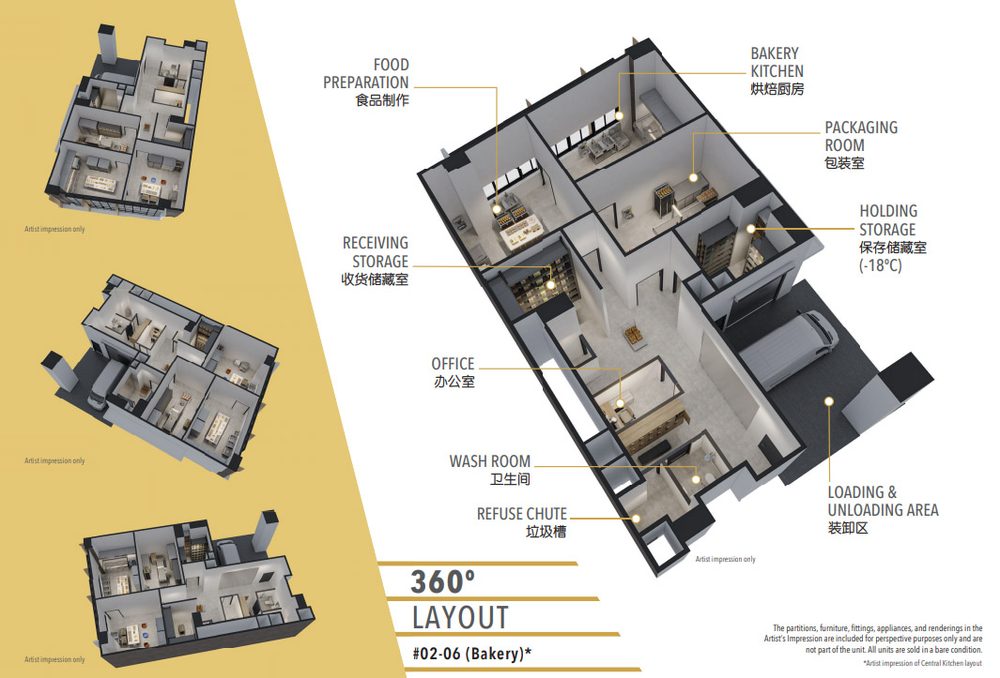
Bakery Configuration
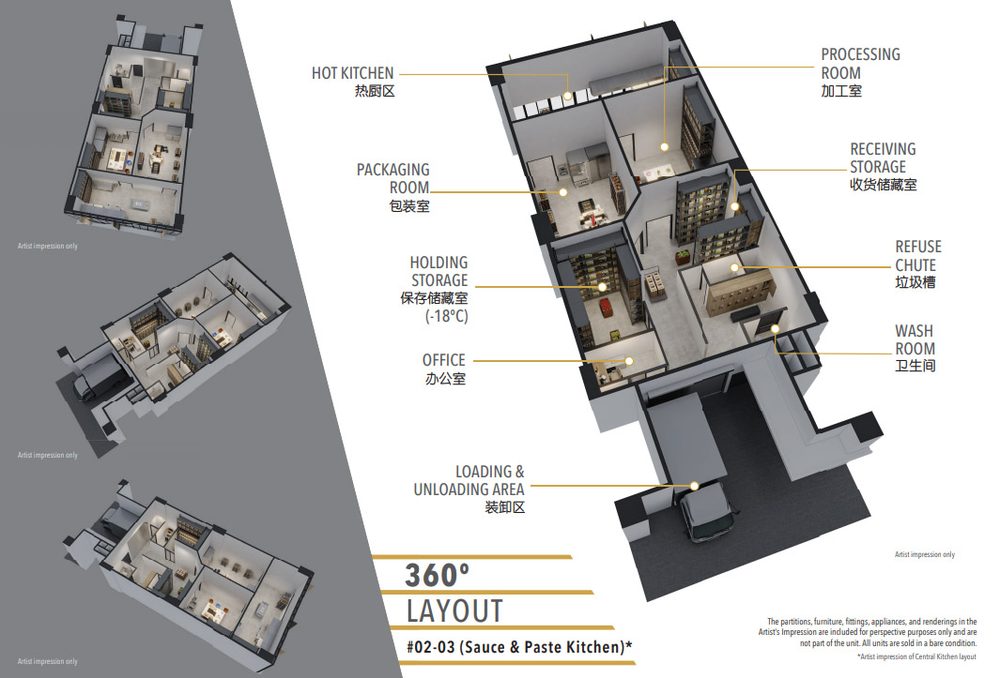
Sauce & Paste Kitchen
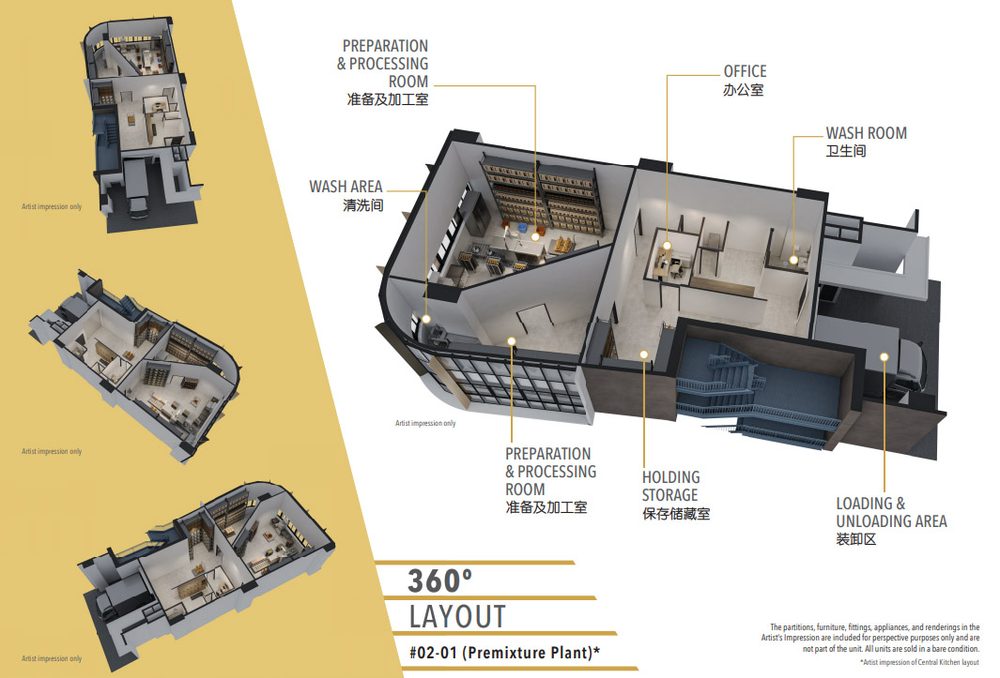
Premixture Plant

Tai Seng — an established F&B and light-industrial cluster.
The Tai Seng cluster has matured into one of Singapore’s most accessible food-manufacturing hubs. Surrounding clusters include Paya Lebar iPark, Bartley Industrial, the Kaki Bukit business cluster, and the Macpherson industrial belt — collectively home to hundreds of central kitchens, packaging operators, sauce works and ready-to-eat producers.
Direct connectivity is among the strongest in central Singapore. The Tai Seng MRT (CC11) interchange is approximately five minutes’ walk away, providing Circle Line access. The wider Tai Seng location sits within ten minutes of Bartley (CC12 / NE13), Serangoon (NE12 / CC13), Paya Lebar (EW8 / CC9) and MacPherson (CC10 / DT26) stations, giving the project effective reach across four MRT lines without a single transfer.
By road, the Pan Island Expressway (PIE) is eight minutes’ drive south, the Central Expressway (CTE) is approximately the same west, and the Kallang-Paya Lebar Expressway (KPE) is immediately to the east. Changi International Airport is around fifteen minutes east, and the Central Business District is roughly twenty minutes south-west.
Longer-term, the Paya Lebar Airbase relocation by 2030 will unlock 150,000 new homes and remove the height restriction that has historically capped this area. Explore the full location analysis for context on infrastructure, demographics and the wider URA Master Plan implications.
Powermatic Data Systems Ltd — an SGX-listed institutional developer.
Powermatic Data Systems Ltd is a Singapore Exchange Mainboard-listed company with more than three decades of operating history. The group is best known for its wireless connectivity hardware business, an officially appointed Qualcomm Authorized Design Centre with a customer base spanning Europe, North America and Asia. The wireless business is the dominant profit contributor.
Alongside the hardware business, Powermatic has held the freehold land at 7 & 9 Harrison Road for many years as part of its property portfolio. The decision to redevelop the site reflects the group’s long-term confidence in central Singapore industrial real estate, and its institutional balance-sheet capacity to undertake a full-scale redevelopment rather than a piecemeal refurbishment.
For prospective buyers, the developer’s SGX listing matters in three concrete ways: continuous disclosure obligations create transparency around financial position; institutional governance reduces counterparty risk during the development period; and a multi-decade dividend track record signals balance-sheet conservatism.
Indicative starting prices from S$2.8m+.
Per-square-foot quanta open from the S$17xx psf range, with pricing varying by floor level, unit type, orientation and stack. The Level 1 units carry mezzanine provision and tend to command a premium to mid-block stacks. The Level 8 units, with their 6.6m ceiling height, often appeal to operations needing taller equipment.
For a precise quote on a specific stack, please consult the balance-units chart for current availability or call the project consultant directly. The chart is updated on a rolling basis as units are reserved or released.
From S$17xx psf · subject to final developer confirmation
Call +65 6200 6220 for the latest indicative quote on any specific unit.
What’s happening at Harrison Food Building and the wider food-factory sector.

Harrison Food Building Sales Launch: What October 2024 Marked
The official sales programme opened in October 2024, positioning Harrison Food Building as one of the few freehold food factory launches in the central region.
Read more →
Food Factories as an Alternative Industrial Asset Class
JTC’s 4Q industrial report flagged multi-user food factory plants as the strongest-performing industrial sub-segment by rental growth. Here’s why the structural drivers point one way.
Read more →
The Singapore Food Factory Opportunity in 2026
Singapore’s 30-by-30 food security agenda, paired with tightening supply of central-region industrial land, has reshaped the medium-term outlook for purpose-built food production space.
Read more →Common questions about Harrison Food Factory.
If your question isn’t covered here, please call the sales hotline at +65 6200 6220 or use the enquiry form.
What is the tenure for Harrison Food Building?
Harrison Food Building is offered on freehold tenure — permanent ownership with no lease decay. This is a meaningful distinction in Singapore’s food factory market, where the overwhelming majority of stock sits on 30 or 60-year JTC leasehold tenure.
Is there a loading and unloading bay?
Yes. Dedicated loading and unloading bays are provided at Level 1, sized to accommodate full goods-vehicle access. Beyond the ground-floor bays, the building features a full vehicular ramp running from Level 1 all the way up to Level 8, allowing direct vehicle access to every floor. This eliminates the cargo-lift bottleneck that constrains throughput in many older food factory buildings.
Does every unit have its own toilet?
Yes. Each production unit at Harrison Food Building comes with its own toilet provision, removing the need for shared facilities. This supports SFA licensing requirements for food handling and minimises operational friction during production hours.
Can a cold room be installed in a unit?
Yes. The floor loading (12.5 kN/m² across production areas), ceiling heights and electrical provisioning have all been specified to accommodate cold room installation. Owner-occupiers planning a freezer, chiller or blast freezer can do so within their unit, subject to the usual building management approvals on common services.
Can the building be used for cloud kitchens or central kitchens?
Yes. Harrison Food Building is pre-approved as a food factory and accommodates the full range of food-related operations, including central kitchens, cloud kitchens, B2B catering production, packaging operations, and food manufacturing. Multiple adjacent units can be combined for larger-format operations.
What types of food processing can operate here?
Because the development is pre-approved as a food factory, the full spectrum of SFA-licensable food-processing activities is permitted. Common use cases include bakery and pastry production, sauce and paste manufacturing, premixture and dry-blending operations, hot-kitchen production, packaging and labelling, and cold-chain handling. Unit type B at Level 1, with its mezzanine and 6.3m ceiling, particularly suits high-throughput production.
Are grease traps provided in every unit?
Yes. Grease traps are provided as standard in every food production unit, sized to support typical food-factory operations and to meet SFA and PUB requirements without additional retrofit work.
Is there a kitchen exhaust duct (KED)?
Yes. Each unit at Harrison Food is provisioned with a Kitchen Exhaust Duct connection routed to the roof for proper extraction of cooking emissions. This is a critical specification for hot-kitchen and bakery operations and is often a costly retrofit in older buildings.
How is waste handled?
A refuse chute is provided in every unit, connecting to a central building waste management system. The building’s waste handling provisions are designed to support food-grade hygiene standards and to streamline daily operational disposal.
What is the difference between a food factory and a food shop?
A food factory holds an SFA Food Factory licence and is permitted to produce, manufacture and cater food products for both business-to-business and business-to-consumer distribution. A food shop, by contrast, is licensed only for direct-to-consumer service and cannot legally supply other businesses. Harrison Food Building is licensed for the broader food factory use case, which gives operators substantially more commercial flexibility — for example, supplying restaurants, retailers, hotels, or running B2B catering alongside any direct retail.
When is the estimated TOP?
Estimated Temporary Occupation Permit (TOP) is targeted for 2028, subject to construction progress and the usual regulatory approvals. For the latest construction milestones and the official handover schedule, please contact the developer sales team directly.
How do I check current pricing and balance unit availability?
Indicative pricing starts from approximately S$2.8 million, with per-square-foot quanta from the S$17xx psf range. For current pricing on a specific stack and the latest balance-unit chart, refer to the pricing guide and the balance units page, or call the developer sales team at +65 6200 6220.